Pingdom alternative: Compare Pingdom to IsDown
IsDown and Pingdom serve different monitoring needs. Learn which tool, or combination, is right for monitoring your third-party dependencies and your own infrastructure.
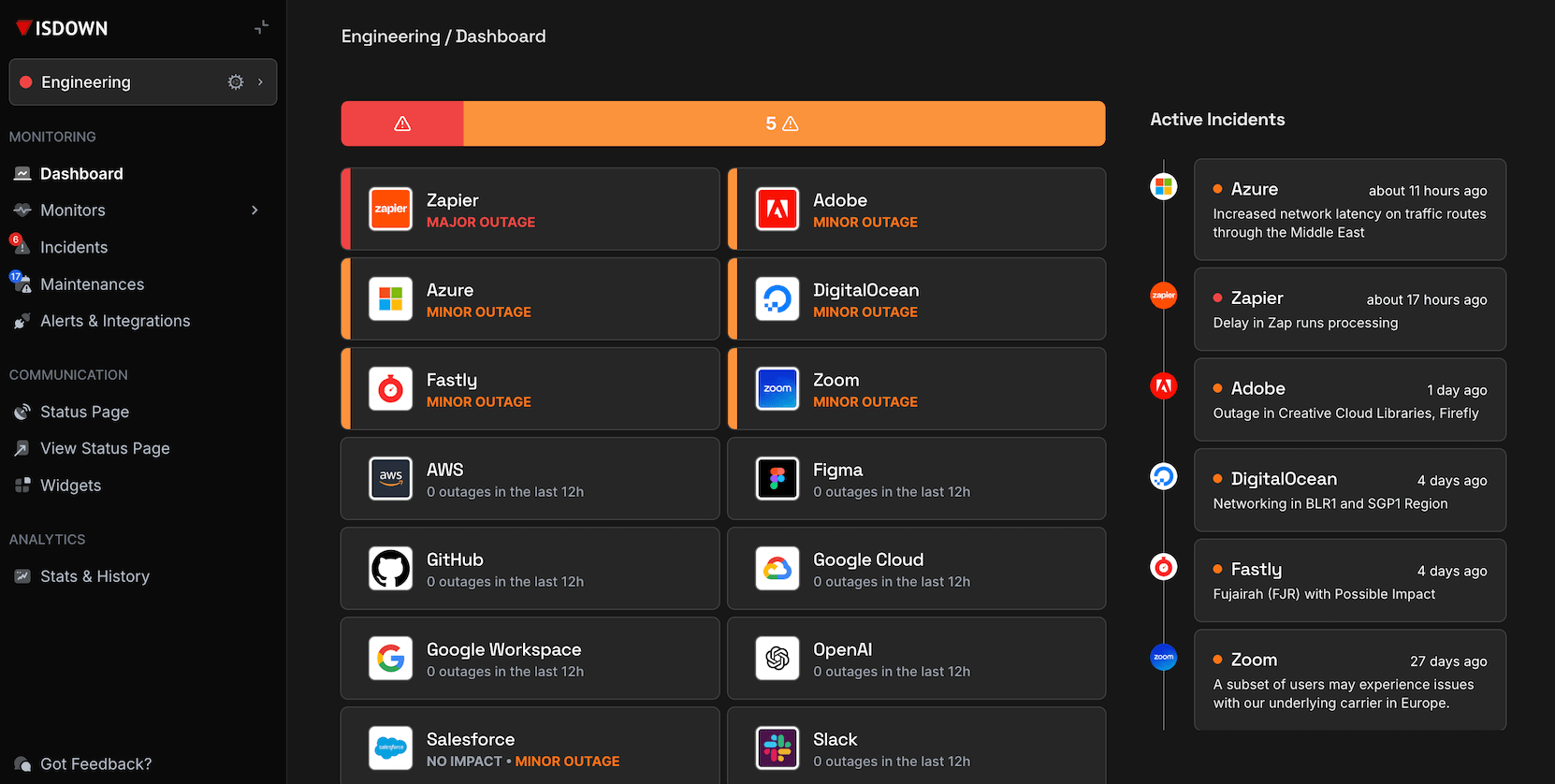









IsDown and Pingdom solve different problems
IsDown
Status Page Aggregator & Uptime Monitoring
Monitors third-party services you depend on (AWS, Stripe, Slack, GitHub, etc.) by aggregating their official status pages. Also includes uptime monitoring for your own endpoints.
Pingdom
Website Performance & Synthetic Monitoring
Monitors your own websites and applications through synthetic checks, transaction monitoring, page speed analysis, and real user monitoring (RUM). Owned by SolarWinds.
Bottom line: IsDown and Pingdom are complementary tools. Pingdom excels at monitoring your own websites with advanced features like transaction testing and RUM. IsDown excels at monitoring third-party service dependencies. Many enterprise teams use both for complete observability.
Quick Comparison at a Glance
Here are the main differences between IsDown and Pingdom:
| Feature |  |
Pingdom |
|---|---|---|
| Primary Purpose | Status Page Aggregation + Uptime Monitoring | Website Performance & Synthetic Monitoring |
| Third-Party Status Monitoring | ✅ 6320+ services | ❌ No |
| Uptime Monitoring | ✅ Yes (HTTP, Ping, Keyword, SSL) | ✅ Yes (100+ locations worldwide) |
| Transaction Monitoring | ❌ No | ✅ Yes (login, checkout, multi-step flows) |
| Real User Monitoring (RUM) | ❌ No | ✅ Yes (browser, device, geo data) |
| Page Speed Analysis | ❌ No | ✅ Yes (detailed load time breakdown) |
| Starting Price | $216/year (15 third-party or website monitors) | $120/year for 10 uptime monitors |
| Status Pages | ✅ Yes (public and private with SSO support) | ✅ Yes (public status pages) |
| Datadog Integration | ✅ Native integration | Via SolarWinds APM |
| Early Outage Detection | ✅ Yes (30+ min before official updates) | N/A (monitors your own endpoints) |
Try IsDown Free for 14 Days
No credit card required • Extend trial if needed
Detailed Feature Comparison
Understanding what each tool excels at helps you make the right choice.
Third-Party Status Aggregation
IsDown monitors 6320+ external services (AWS, Stripe, GitHub, Slack, etc.) by aggregating their official status pages. Get detailed incident information, affected components, and vendor timelines. Pingdom: Does not monitor third-party status pages, it focuses exclusively on your own infrastructure.
Synthetic Monitoring
Pingdom, is an industry-leading synthetic monitoring tool with 100+ global locations, testing your websites and APIs from around the world. Includes uptime checks, transaction monitoring, and page speed analysis. IsDown, on the other hand, offers uptime monitoring (HTTP/HTTPS, Ping, Keyword) with 1-5 minute intervals. Less comprehensive but sufficient for basic needs.
Real User Monitoring (RUM)
Pingdom captures real user experience data, and how actual visitors experience your site based on their browser, device, and location. Track performance trends, identify bottlenecks, and compare metrics over time. IsDown does not offer RUM, it focuses on status page aggregation rather than user experience metrics.
Transaction Monitoring
Pingdom tests complex user flows like login, signup, checkout, and search. Simulate real user interactions to ensure critical business processes work correctly. Catch issues before users do. IsDown does not offer transaction monitoring, it focuses on detecting when third-party services have issues.
Early Warning Detection
IsDown, has a unique early warning system that detects third-party outages 30+ minutes before official vendor updates by monitoring user reports and social signals. Critical for proactive incident management. Pingdom monitors your own infrastructure, it has no early warning capability for third-party services.
Integrations & Ecosystem
IsDown, has native integrations with Datadog, PagerDuty, Slack, Teams, OpsGenie, Incident.io, FireHydrant, and more. Designed for modern incident management workflows. Pingdom is part of SolarWinds ecosystem with APM Integrated Experience. Webhooks, API access, and integrations via their platform.
Which Tool Should You Use?
Website Performance
You need to monitor your website's speed, uptime from multiple locations, test user flow.
Recommendation:
Use Pingdom
Pingdom's synthetic monitoring, transaction testing, and RUM provide comprehensive visibility into your website's performance.
Third-Party Services
You depend on external services (AWS, Stripe, Slack, etc.) and need visibility into their status and outages.
Recommendation:
Use IsDown
IsDown aggregates 6320+ third-party status pages, provides early warning detection, and integrates with Datadog, PagerDuty, and more.
Complete Observability
You need comprehensive monitoring: website performance AND third-party dependencies.
Recommendation:
Use both tools
Combine Pingdom for advanced website monitoring with IsDown for third-party status aggregation. Many enterprise teams use both for complete visibility.
Pricing Comparison
Starter Plan
$216/year
15 monitors, status pages + uptime
Pro Plan
$444/year
30 monitors, most integrations
Premium Plan
$888/year
70 monitors, PagerDuty, Datadog
Includes: Status page aggregation, uptime monitoring, SSL monitoring, all notification channels
Pingdom
Synthetic Monitoring (Basic)
$120/year
10 uptime checks, 1 advanced check, 50 SMS
Real User Monitoring (Basic)
$120/year
100,000 pageviews
Enterprise
Contact Sales
Custom pricing for high-volume needs
Includes: Synthetic monitoring, transaction testing, RUM, page speed analysis, 100+ global locations
Note: These tools serve different purposes. IsDown's pricing includes third-party status aggregation (which Pingdom doesn't offer), while Pingdom's pricing includes advanced synthetic monitoring and RUM (which IsDown doesn't offer). Compare based on the specific capabilities you need.
Frequently Asked Questions
Can I use IsDown and Pingdom together?
Yes! Many enterprise teams use both: Pingdom for synthetic monitoring, transaction testing, and real user monitoring of their own websites, while IsDown monitors third-party service dependencies (AWS, Stripe, Slack, etc.). This combination provides complete visibility across your own infrastructure and external services you depend on.
Which tool is better for monitoring third-party services?
IsDown is specifically designed for third-party status monitoring, aggregating 6320+ official vendor status pages. Pingdom focuses on monitoring your own websites and applications. While you could configure Pingdom to ping external services, it won't give you incident details, affected components, or official vendor updates like IsDown does.
Does IsDown replace Pingdom?
It depends on your needs. IsDown includes uptime monitoring for your own endpoints, but Pingdom offers more advanced features like transaction monitoring, real user monitoring (RUM), and page speed analysis. If you primarily need third-party status aggregation with basic uptime monitoring, IsDown is sufficient. If you need advanced synthetic monitoring and RUM, you may want both tools.
What's the main difference between IsDown and Pingdom?
Pingdom monitors YOUR websites and applications using synthetic checks, transaction tests, and real user data. IsDown monitors THIRD-PARTY services you depend on by aggregating their official status pages. Pingdom answers "Is my website fast and available?" while IsDown answers "Is AWS/Stripe/GitHub having issues?"
Does Pingdom offer third-party status page monitoring?
No. Pingdom focuses exclusively on monitoring your own infrastructure through synthetic checks, transaction monitoring, and real user monitoring. It doesn't aggregate third-party vendor status pages. For visibility into AWS, Stripe, GitHub, Slack, and other external dependencies, you need IsDown.
Which integrates better with Datadog?
IsDown offers native Datadog integration, streaming third-party service status directly into your Datadog dashboards. Pingdom is owned by SolarWinds and integrates with their APM suite. While both can send alerts to various platforms, IsDown's Datadog integration is specifically designed for correlating third-party outages with your infrastructure metrics.
What about transaction monitoring and RUM?
Pingdom offers advanced transaction monitoring (testing complex user flows like checkout, login, etc.) and Real User Monitoring (RUM) to understand actual user experience. IsDown doesn't offer these features—it focuses on status page aggregation and basic uptime monitoring. If you need transaction testing or RUM, Pingdom is the better choice for that specific need.
Which tool is more affordable for small teams?
IsDown starts at $216/year for 15 monitors including status page aggregation, uptime monitoring and a status page. Pingdom's Synthetic Monitoring starts at $120/year for 10 uptime checks. However, they solve different problems: Pingdom monitors your own websites with advanced features, while IsDown monitors third-party services. Choose based on what you need to monitor.
Ready to Get Complete Third-Party Visibility?
14-day free trial · No credit card required · No code required