Need more than Uptime.com's Cloud Status feature?
Uptime.com monitors your infrastructure. But if third-party vendor monitoring is your primary need, IsDown gives you 6320+ services, early outage detection, and integrations built specifically for incident response teams.
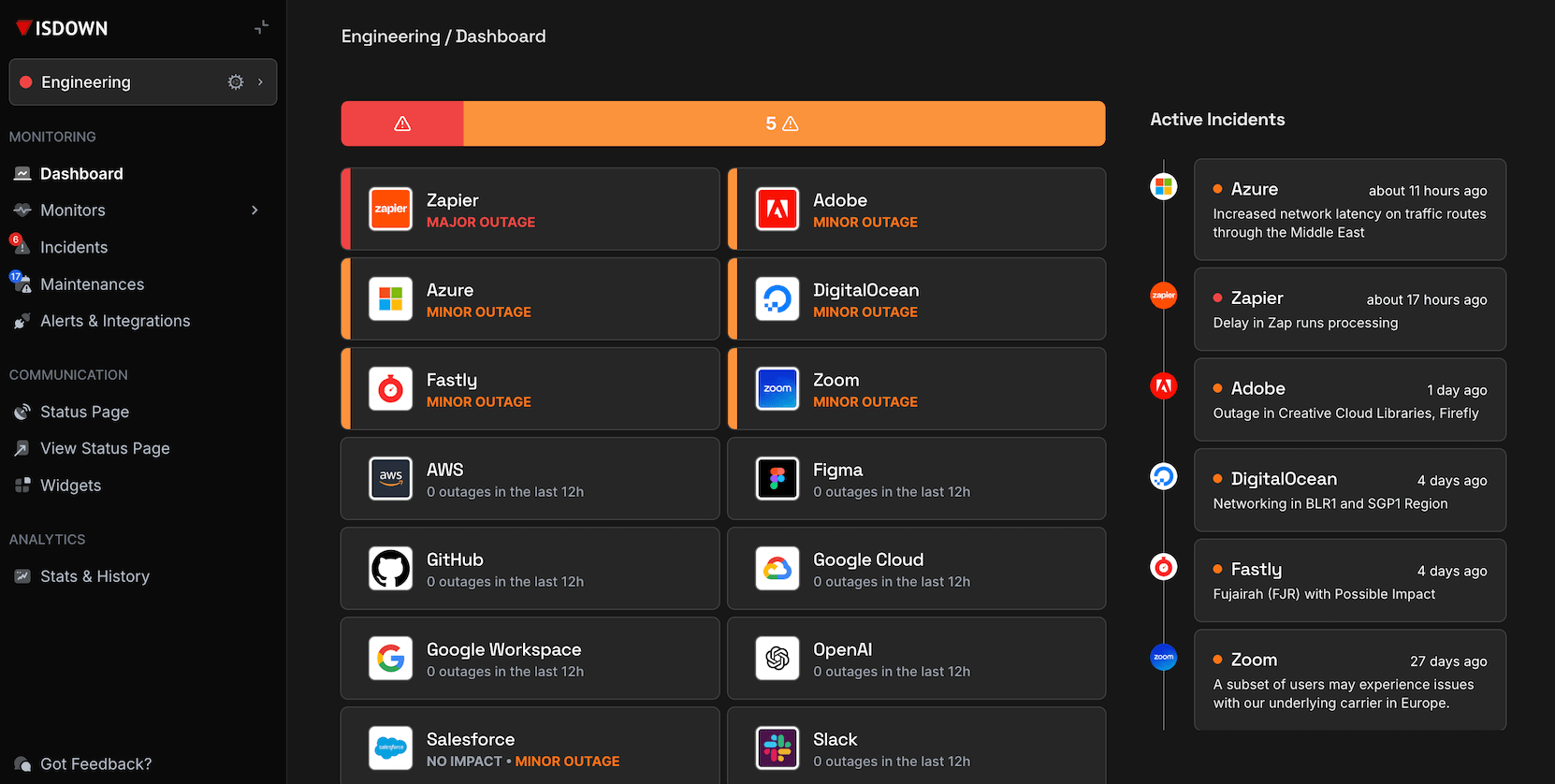









Vendor monitoring as a feature vs. the entire product
IsDown
Purpose-Built Vendor Monitoring Platform
Built from the ground up for third-party vendor monitoring. Covers 6320+ services with early outage detection, component-level tracking, and deep incident management integrations. Vendor monitoring is the core product.
Uptime.com
Uptime Monitoring Platform with Cloud Status Feature
A comprehensive uptime monitoring tool with synthetic checks, transaction monitoring, and RUM. Cloud Status is a feature within the platform, covering ~1,200 vendors. Not the primary focus.
Bottom line: Uptime.com is a great uptime monitoring tool. But vendor monitoring is a feature, not the core product. If third-party dependency monitoring is your primary need, IsDown gives you 5x the coverage and a platform built specifically for this use case.
At a Glance Comparison
How IsDown and Uptime.com's Cloud Status feature compare for vendor monitoring:
| Feature |  |
Uptime.com Cloud Status |
|---|---|---|
| Services Monitored | 6320+ services | ~1,200 cloud vendors |
| Primary Focus | Vendor monitoring (core product) | Feature within uptime monitoring platform |
| Early Outage Detection | ✅ Before vendors acknowledge | ❌ Relies on official status pages |
| Incident Management Integrations | ✅ PagerDuty, Rootly, FireHydrant, Incident.io, Squadcast | Standard alerts only |
| Component-Level Tracking | ✅ Track individual components (e.g., AWS EC2, S3) | Basic vendor-level status |
| Pricing Model | Focused on vendor monitoring use case | Bundled with full uptime platform |
| Setup Time | ~5 minutes | Part of broader platform setup |
| Datadog Integration | ✅ Native integration | Via Uptime.com platform |
| Status Pages | ✅ Public & private with SSO | ✅ Public status pages |
Try IsDown Free for 14 Days
No credit card required
Where IsDown Wins
IsDown is purpose-built for the vendor monitoring use case. Here is where it makes a difference:
5x More Service Coverage
IsDown monitors 6320+ third-party services compared to Uptime.com's ~1,200. This includes major cloud providers, SaaS platforms, payment processors, CDNs, and niche tools your team depends on. Broader coverage means fewer blind spots when a dependency goes down.
Early Outage Detection
IsDown detects outages 30+ minutes before vendors officially acknowledge them by monitoring social signals and user reports. Uptime.com Cloud Status relies on official vendor status page updates, meaning you find out when the vendor decides to tell you. Early detection is critical for proactive incident management.
Incident Management Integrations
IsDown natively integrates with PagerDuty, Rootly, FireHydrant, Incident.io, Squadcast, Datadog, OpsGenie, Slack, Teams, and more. When a vendor has an outage, your incident response team is automatically notified through the tools they already use. Uptime.com provides standard alerting but lacks these deep incident management integrations.
Component-Level Monitoring
IsDown lets you monitor individual service components. Instead of just tracking 'AWS status', you can monitor specific services like EC2, S3, Lambda, or RDS independently. Get alerts only for the components you actually use. Uptime.com's Cloud Status provides vendor-level status without this level of granularity.
Internal Status Pages
IsDown lets you create internal status pages that aggregate your third-party vendor dependencies into a single view for your team. Share real-time vendor status with engineering, support, and leadership. Supports SSO, custom domains, and subscriber notifications. Built specifically for communicating third-party status internally.
Focused Pricing
IsDown's pricing is built around vendor monitoring. You pay for what you need without subsidizing synthetic monitoring, transaction checks, or RUM features you don't use. With Uptime.com, Cloud Status comes bundled with their full platform, meaning you pay for capabilities beyond vendor monitoring.
Which Tool Should You Use?
Full Uptime Monitoring
You need synthetic monitoring, transaction checks, RUM, and vendor monitoring is secondary.
Recommendation:
Use Uptime.com
Uptime.com's platform provides comprehensive monitoring for your own infrastructure, with Cloud Status as a bonus.
Vendor Monitoring First
Your primary need is monitoring third-party dependencies with deep coverage and early detection.
Recommendation:
Use IsDown
IsDown covers 6320+ services with early detection and incident management integrations your team already uses.
Complete Observability
You need advanced uptime monitoring AND deep vendor coverage with early detection.
Recommendation:
Use both tools
Combine Uptime.com for your own infrastructure with IsDown for comprehensive third-party visibility and incident response workflows.
When Uptime.com Makes Sense
Uptime.com is a solid monitoring platform. If your team needs synthetic uptime monitoring for your own services AND vendor monitoring, it is a reasonable all-in-one choice. Cloud Status is a solid feature within their platform.
Uptime.com makes more sense when:
- You need synthetic monitoring, transaction checks, and RUM for your own websites
- Vendor monitoring is a nice-to-have, not your primary need
- You prefer an all-in-one platform over best-of-breed tools
- 1,200 vendor integrations covers all the services you depend on
When IsDown Makes More Sense
- Your primary need is monitoring third-party vendor dependencies, not your own infrastructure
- You need coverage of 6320+ services, not ~1,200
- Your team needs early detection, knowing about outages before the vendor acknowledges them
- You want deep integrations with incident management tools (PagerDuty, Rootly, FireHydrant, etc.)
- You do not want to pay for synthetic monitoring you do not need
- You need component-level monitoring (e.g., tracking AWS EC2 separately from S3)
Pricing Comparison
Starter Plan
$264/year
15 monitors, status pages + uptime
Pro Plan
$480/year
30 monitors, all notification channels
Premium Plan
$960/year
70 monitors, most integrations, SSO
Includes: Vendor status aggregation, uptime monitoring, SSL monitoring, status pages, all notification channels
Uptime.com
Infrastructure Plan
Custom Pricing
Synthetic + RUM + Cloud Status
Premium Plan
Custom Pricing
Advanced features + API monitoring
Enterprise
Contact Sales
Custom volume, dedicated support
Includes: Synthetic monitoring, transaction testing, RUM, Cloud Status (~1,200 vendors), status pages
Note: IsDown's pricing is focused specifically on vendor monitoring. You get 6320+ services, early detection, and incident management integrations without paying for synthetic monitoring features. Uptime.com bundles Cloud Status with their full monitoring platform, which may include capabilities you do not need if vendor monitoring is your priority.
Frequently Asked Questions
How does IsDown compare to Uptime.com for vendor monitoring?
IsDown is a purpose-built vendor monitoring platform covering 6320+ third-party services. Uptime.com's Cloud Status feature covers around 1,200 vendors but is a secondary feature within a broader uptime monitoring platform. If vendor monitoring is your primary need, IsDown provides deeper coverage, early outage detection, and more incident management integrations.
Does Uptime.com offer early outage detection like IsDown?
No. Uptime.com's Cloud Status reports vendor status based on official status page updates. IsDown detects outages before vendors officially acknowledge them using social signals and user reports, often alerting you 30+ minutes earlier than official updates.
How many services does each platform monitor?
IsDown monitors 6320+ third-party services. Uptime.com's Cloud Status feature covers approximately 1,200 cloud vendors. IsDown provides significantly broader coverage, especially for niche SaaS tools and regional services.
Can IsDown replace Uptime.com entirely?
It depends on your needs. If you primarily need third-party vendor monitoring, IsDown is the better choice. IsDown also includes uptime monitoring for your own endpoints. However, if you need Uptime.com's advanced synthetic monitoring, transaction checks, or RUM features, you may want to keep both tools.
What integrations does IsDown support that Uptime.com doesn't?
IsDown offers native integrations with PagerDuty, Rootly, FireHydrant, Incident.io, Squadcast, Datadog, OpsGenie, and more incident management platforms. These integrations are specifically designed for incident response workflows around third-party outages.
Does Uptime.com's Cloud Status provide component-level monitoring?
Uptime.com's Cloud Status provides basic vendor status information. IsDown provides granular component-level monitoring, so you can track specific services like AWS EC2, S3, or Lambda individually rather than just the overall AWS status.
Which tool is better for incident response teams?
IsDown is designed specifically for incident response workflows. It integrates directly with PagerDuty, Rootly, FireHydrant, Incident.io, and other incident management tools. When a third-party vendor has an outage, your team is automatically notified through the tools they already use.
Is IsDown more affordable than Uptime.com for vendor monitoring?
If vendor monitoring is your primary need, yes. IsDown starts at $264/year for 15 monitors including vendor status monitoring, uptime checks, and a status page. With Uptime.com, you need to purchase their broader monitoring platform to access Cloud Status, which may include features you do not need.
Ready to Get Complete Third-Party Visibility?
14-day free trial · No credit card required · No code required