Microsoft Azure status updated
Microsoft Azure is working normally
Number of user-reported issues for Microsoft Azure over the past 24 hours, grouped into 20-minute intervals. It's normal to see occasional reports, which may be due to individual user issues rather than a broader problem. We only consider an issue widespread if there are multiple reports within a short timeframe.
See where Microsoft Azure users are reporting performance issues or even downtime. The map shows recent reports from around the world.
Top locations, last 24h:
See what users are saying about Microsoft Azure issues that impacted them and how they are affected by the outage.
Pawel - All my app services are unavailable.
Joe - I can see this in the Azure Portal: Active: Active - App Service intermittent availability issues in UK South.
Alin - Managed DevOps Pools agents fail to be provisioned in West Europe region.
Pedro - dev.azure.com and portal.azure both down.
Mo - Cannot access Azure Portal company wide.
Seems like the Azure Portal is down again.
Microsoft Azure Government Cloud Portal is down. Returning internal server errors and connection errors..
Cognitive services is slow.
Response - Calls to gpt-4o-mini take >20 seconds.
some teams services are not working.
In the last 90 days, Microsoft Azure had 14 incidents (2 major outages and 12 minor incidents) with a median duration of 2 hours 4 minutes.
Incidents
Major Outages
Minor Incidents
Median Resolution
IsDown has tracked 166 incidents since started monitoring Microsoft Azure status in December 2021. We collect data from 5420+ services, and normalize the data to give you a clear picture of the impact of the outage. It will show official Microsoft Azure outages and also issues that we're started by a spike in crowdsource reports.
| Title | Started At | Duration |
|---|---|---|
|
We have received alerts of an issue ongoing in the West US 2 region. We are actively investigatin...
|
Jan 10, 2026 at 06:21 PM UTC
|
15 minutes |
|
Impact StatementStarting on 10 January 2026 (UTC), customers may experience service disruptions f...
|
Jan 10, 2026 at 05:55 PM UTC
|
about 3 hours |
|
Customers using Cisco Umbrella (OpenDNS) experienced DNS resolution issues when accessing portal....
|
Dec 30, 2025 at 03:14 PM UTC
|
about 1 hour |
|
Customers using Cisco Umbrella (OpenDNS) experienced DNS resolution issues when accessing portal....
|
Dec 30, 2025 at 03:04 PM UTC
|
13 minutes |
|
Customers using OpenDNS are experiencing DNS resolution failures when accessing portal.azure.com ...
|
Dec 30, 2025 at 02:25 PM UTC
|
39 minutes |
|
Customers using OpenDNS experienced DNS resolution issues when accessing portal.azure.com and oth...
|
Dec 30, 2025 at 01:29 PM UTC
|
about 1 hour |
|
Impact Statement: Starting at 12:26 UTC on 22 December 2025, a subset of customers using Microsof...
|
Dec 22, 2025 at 12:26 PM UTC
|
about 7 hours |
|
Impact Statement: Starting at 11:15 EST on 08 December 2025, a subset of customers using resource...
|
Dec 08, 2025 at 04:15 PM UTC
|
about 4 hours |
|
Impact Statement:Starting at 16:50 China Standard Time (CST) on 08 December 2025, customers in Az...
|
Dec 08, 2025 at 08:50 AM UTC
|
about 9 hours |
|
Starting Nov 21, 15:06 UTC, some customers in USGov Arizona may have experienced brief packet dro...
|
Nov 21, 2025 at 04:05 PM UTC
|
12 minutes |
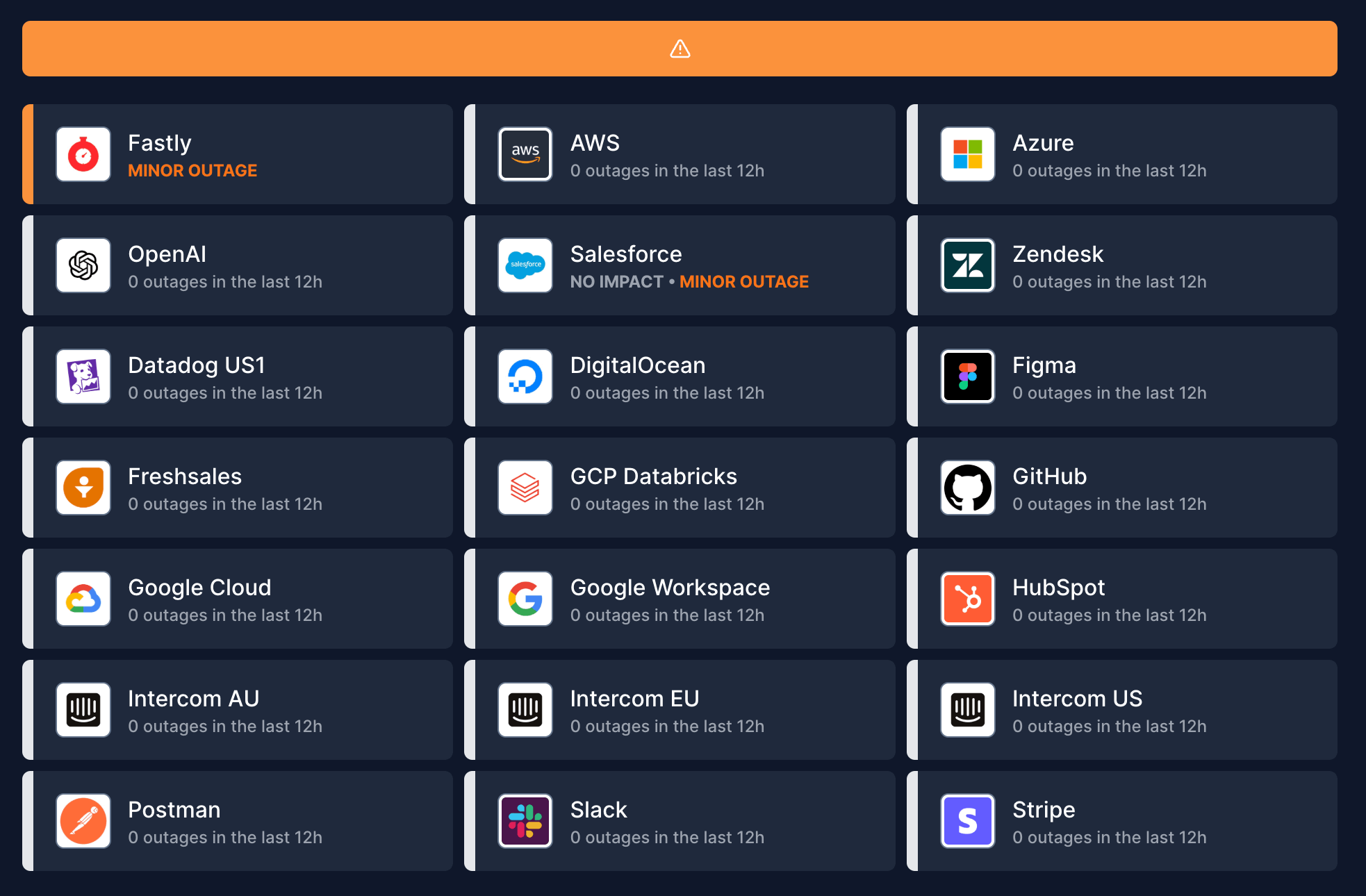
Check the current status of the 63 components, services, or regions being monitored for Microsoft Azure.
Compare uptime, outage stats, and incident history between Microsoft Azure and its alternatives.
IsDown has maintained continuous monitoring of Microsoft Azure, a Cloud Platforms solution, since December 2021. Our database contains 166 documented incidents from the past 4 years, giving us deep insight into Microsoft Azure's reliability patterns and typical resolution times. We parse Microsoft Azure's official status page across all 5,884 components and 63 groups, interpreting statuses like good, warning, critical, and informational to deliver precise uptime metrics and targeted notifications.
When Microsoft Azure experiences issues, you need accurate information fast. IsDown combines official status page data with user-reported issues, giving you early detection when vendors are slow to acknowledge problems, plus verified incident details once they do. You get affected components, severity levels, and real-time resolution updates from both sources.
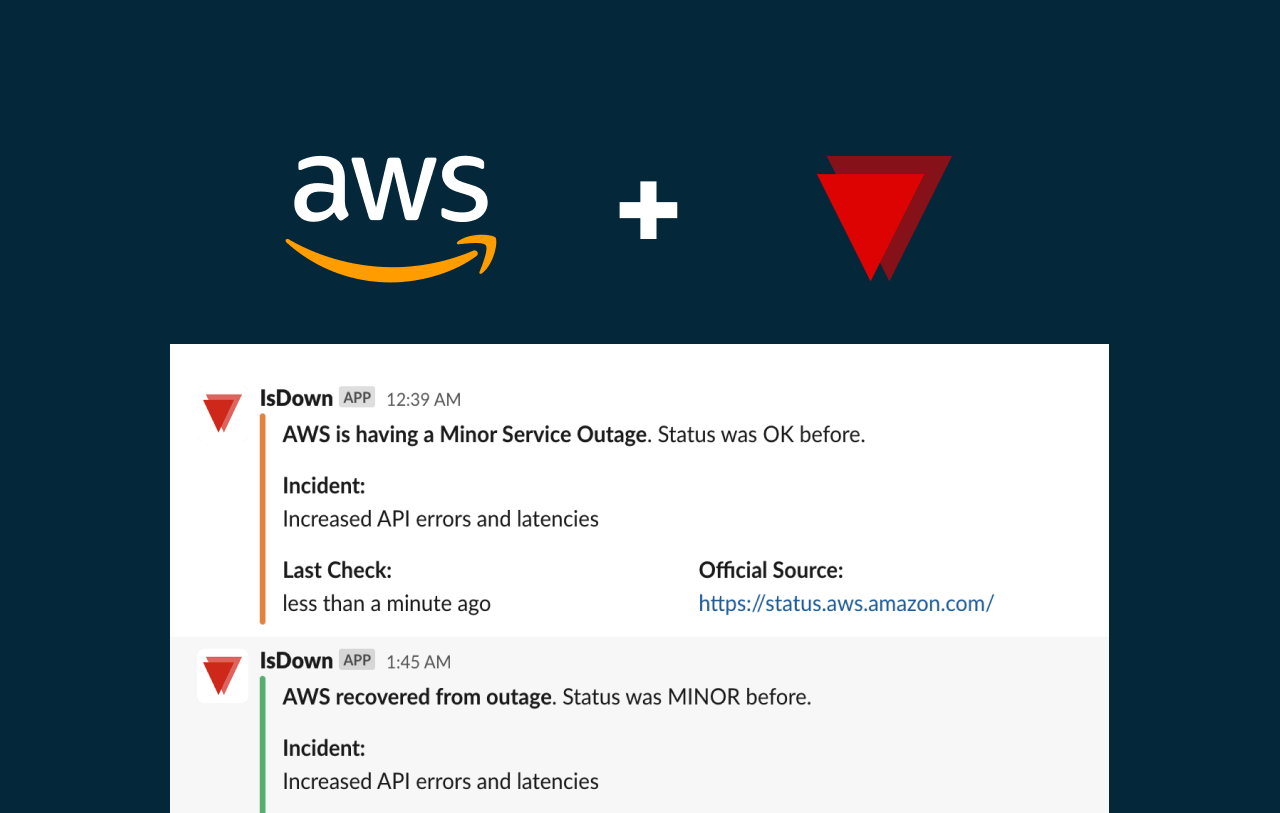
Engineering and operations teams rely on IsDown to monitor Microsoft Azure and receive verified outage alerts. Get instant notifications through Slack, Teams, PagerDuty, or 20+ other integrations.
Every few minutes we check the status page of Microsoft Azure (and 5,420+ other services) for issues. We collect the status and outage information across all 5,884 Microsoft Azure components. We also monitor user reports alongside official sources. Since vendors often take time to report incidents, monitoring user reports helps us alert you early.
Not only will you get notified, but IsDown offers notification filters so you can choose which issues you want to be alerted about. This way you avoid getting all incidents from Microsoft Azure and other services, focusing only on those affecting your business.
IsDown checks Microsoft Azure official status page for major/minor outages or downtimes. A major outage is when Microsoft Azure experiences a critical issue that severely affects one or more services/regions. A minor incident is when Microsoft Azure experiences a small issue affecting a small percentage of its customer's applications. An example is the performance degradation of an application. The moment we detect a Microsoft Azure outage, we send you an alert and update your dashboard and status page.
Microsoft Azure and other vendors don't always report outages on time. IsDown collects user reports to provide early detection of outages. This way, even without an official status update, you can stay ahead of possible problems.
IsDown collects all information from the outages published in Microsoft Azure status page to provide the context of the outage. If available, we gather the title, description, time of the outage, status, and outage updates. Another important piece of information is the affected services/regions which we use to filter the notifications that impact your business.
IsDown monitors Microsoft Azure and all their 5884 components that can be affected by an outage. IsDown allows you to filter the notifications and status page alerts based on the components you care about. For example, you can choose which components or regions affect your business and filter out all other outages. This way you avoid alert fatigue in your team.
Our tool was built to be the best way to monitor all your external dependencies in one place. IsDown not only will help you monitor Microsoft Azure but also 5,421 other services. Your team and customers will have a clear view of all your dependencies and their status, making it easier to identify and resolve issues.
Add all your dependencies to your dashboard. IsDown will monitor them in real-time and send you alerts when there is an issue. You can also create a status page for a bird's-eye view and share it with your team.
Start Monitoring for Free
Not only will you get notified, but IsDown offers notification filters so you can choose which issues you want to be notified about. This way you avoid getting all incidents from Microsoft Azure and other services.
Start Monitoring for Free
IsDown integrates with 20+ tools. Connect the status of Microsoft Azure and 5,420 other vendors to your tools to receive vendor outage alerts exactly where your team needs them.
Start Monitoring for Free
Create a status page that can easily be accessed by your team and customers. You can make it public or private, and customize it to your needs. This will be your first line of communication when there's the question 'Is Microsoft Azure down?'
Start Monitoring for Free
Need similar to Downdetector Microsoft Azure alerts? IsDown might be the solution for you. While Downdetector relies on user-submitted reports to detect Microsoft Azure outages, IsDown monitors Microsoft Azure's status page for verified, detailed incident information. Here's why official monitoring provides better reliability for your business:
| Features |
|
Downdetector |
|---|---|---|
| Official Microsoft Azure status page monitoring with real-time incident details. | ||
| Monitor 5,420+ services including Microsoft Azure in a single dashboard. | ||
| Instant Microsoft Azure outage alerts sent to Slack, Teams, PagerDuty, and more. | ||
| Combined monitoring of Microsoft Azure official status and user-reported issues. | ||
| Maintenance feed for Microsoft Azure | ||
| Granular alerts filtering by Microsoft Azure components and regions. |
14-day free trial • No credit card required
Microsoft Azure isn't down. You can check Microsoft Azure status and incident details on the top of the page. IsDown continuously monitors Microsoft Azure official status page every few minutes. In the last 24 hours, there were 0 outages reported.
Microsoft Azure is currently operational. You can check Microsoft Azure status and incident details on the top of the page. The status is updated in almost real-time, and you can see the latest outages and issues affecting customers.
No, there is no ongoing official outage. Check on the top of the page if there are any reported problems by other users.
Currently there's no report of Microsoft Azure being slow. Check on the top of the page if there are any reported problems by other users.
IsDown monitors the Microsoft Azure official status page every few minutes. We also get reports from users like you. If there are enough reports about an outage, we'll show it on the top of the page.
Microsoft Azure last outage was on January 10, 2026 with the title "Active - Datacenter power event - Recovery ongoing"
Because IsDown is a status page aggregator, which means that we aggregate the status of multiple cloud services. You can monitor Microsoft Azure and all the services that impact your business. Get a dashboard with the health of all services and status updates. Set up notifications via Slack, Datadog, PagerDuty, and more, when a service you monitor has issues or when maintenances are scheduled.
IsDown and DownDetector help users determine if Microsoft Azure is having problems. The big difference is that IsDown is a status page aggregator. IsDown monitors a service's official status page to give our customers a more reliable source of information instead of just relying on reports from users. The integration allows us to provide more details about Microsoft Azure's Outages, like incident title, description, updates, and the parts of the affected service. Additionally, users can create internal status pages and set up notifications for all their third-party services.
14-day free trial · No credit card required · No code required